


























































































































































































































































































































































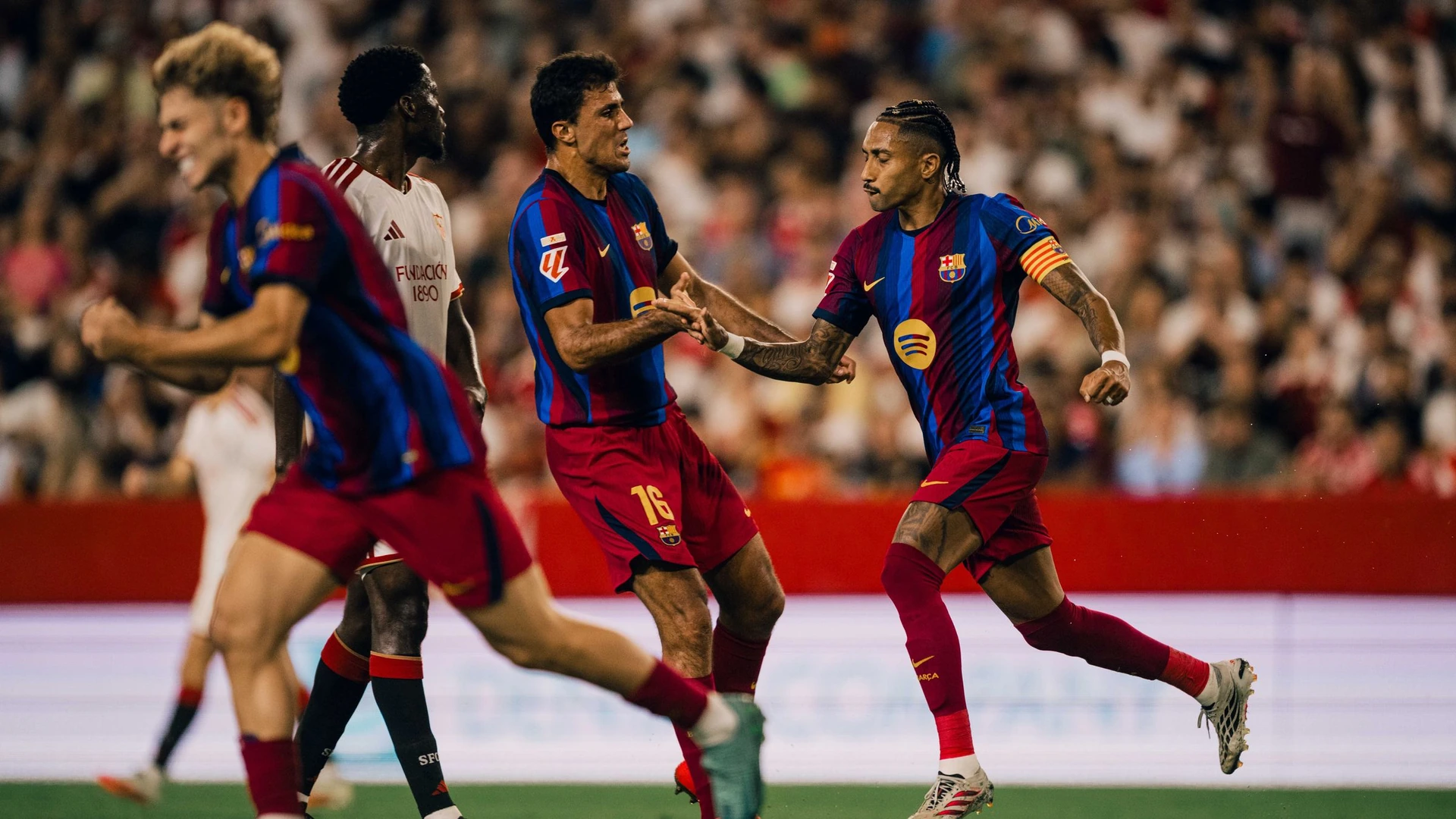
Barcelona defeated Sevilla 3-1 away from home after responding calmly to an uncomfortable opening phase. Raphinha supplied all three Barcelona goals, but the result was built on more than finishing. Barcelona improved the position of its midfield, stopped giving Sevilla easy exits and made better use of the width around the hosts’ compact defensive line.
Sevilla made the first phase difficult
The hosts pressed the first pass and tried to force Barcelona toward crowded areas. Their early approach stopped Barcelona from settling into a comfortable rhythm.
The visitors had to move the ball more quickly instead of waiting for an obvious central route. That adjustment created the space from which the match eventually changed. Sevilla’s pressure initially made Barcelona receive with a defender close behind. The visitors improved by offering a second short option and moving the next pass before the press could collapse, which reduced the number of isolated duels near the touchline. A quicker support angle also protected Barcelona from losing the ball with its structure stretched. When Sevilla closed one receiver, the next pass was close enough to keep possession moving rather than forcing a blind clearance.
Raphinha attacked the spaces that opened
The Brazilian did not remain fixed to one wing while Barcelona circulated possession. His movement behind midfield gave teammates a forward option when Sevilla stepped toward the ball.
Each finish came from a different attacking situation rather than one repeated pattern. The hat-trick therefore reflected reading of space as much as accuracy in front of goal. Raphinha’s movement was difficult to follow because he did not wait in one starting position. He could arrive behind a midfielder, move inside a full-back or attack the far side, forcing Sevilla to pass responsibility between defenders during the same action. The three finishes demonstrate why off-ball timing matters. Raphinha reached the scoring area as the defence turned toward another threat, gaining a fraction of space before the final touch.
| Match element | Barcelona’s response |
|---|---|
| Early pressure | Faster support around the first pass |
| Wide defence | Movement between wing and half-space |
| Transitions | Shorter distances after losing the ball |
| Final score | Barcelona 3-1 Sevilla |
The midfield restored control
Barcelona shortened the distance between the ball carrier and the nearest supporting player. That made lost possession easier to recover before Sevilla could launch a direct attack.
The visiting side also became more patient when the first forward pass was unavailable. Control grew because the team stopped treating every possession as an invitation to accelerate. Once the midfield distances improved, Barcelona recovered more loose balls near the original attack. That control stopped Sevilla from turning every clearance into an open counterattack and allowed the visitors to build another phase without running back toward their own goal. Midfield control did not remove attacking ambition. It made acceleration selective, allowing Barcelona to attack when the opponent was moving and recycle the ball when Sevilla had already closed the route.
Sevilla’s goal kept the match competitive
The hosts continued to threaten when Barcelona left a gap around the edge of its defensive block. Their goal prevented the match from becoming a routine exercise.
Barcelona answered without opening the game unnecessarily and protected the centre more carefully. That response was important because the score alone did not remove Sevilla’s counterattacking threat. Sevilla’s goal confirmed that the home side could still punish space when Barcelona’s protection became loose. The visitors responded by keeping a midfielder closer to the centre and asking the nearest winger to recover before the next attack expanded. The response after conceding was a useful measure of maturity. Barcelona restored spacing instead of adding another forward immediately, preventing the match from becoming a sequence of uncontrolled attacks.
The result offers a repeatable lesson
A productive attack was supported by cleaner distances behind the ball. Raphinha decided the score, while collective positioning allowed his contribution to remain decisive.
Barcelona can carry that balance into matches where finishing opportunities are less frequent. Sevilla leave with evidence that their pressure can disturb strong opponents, but it must be sustained for longer. The hat-trick will define the score, but the performance becomes repeatable only through the structure around it. Raphinha can continue to attack aggressively when teammates protect possession, support the next pass and close the first route after a turnover. Sevilla can build on the disruption created early, but the press needs support for the next pass. Once Barcelona escaped the first line, the hosts were forced to defend too much open space around their midfield.
Comments
No comments yet — be the first to share your thoughts.